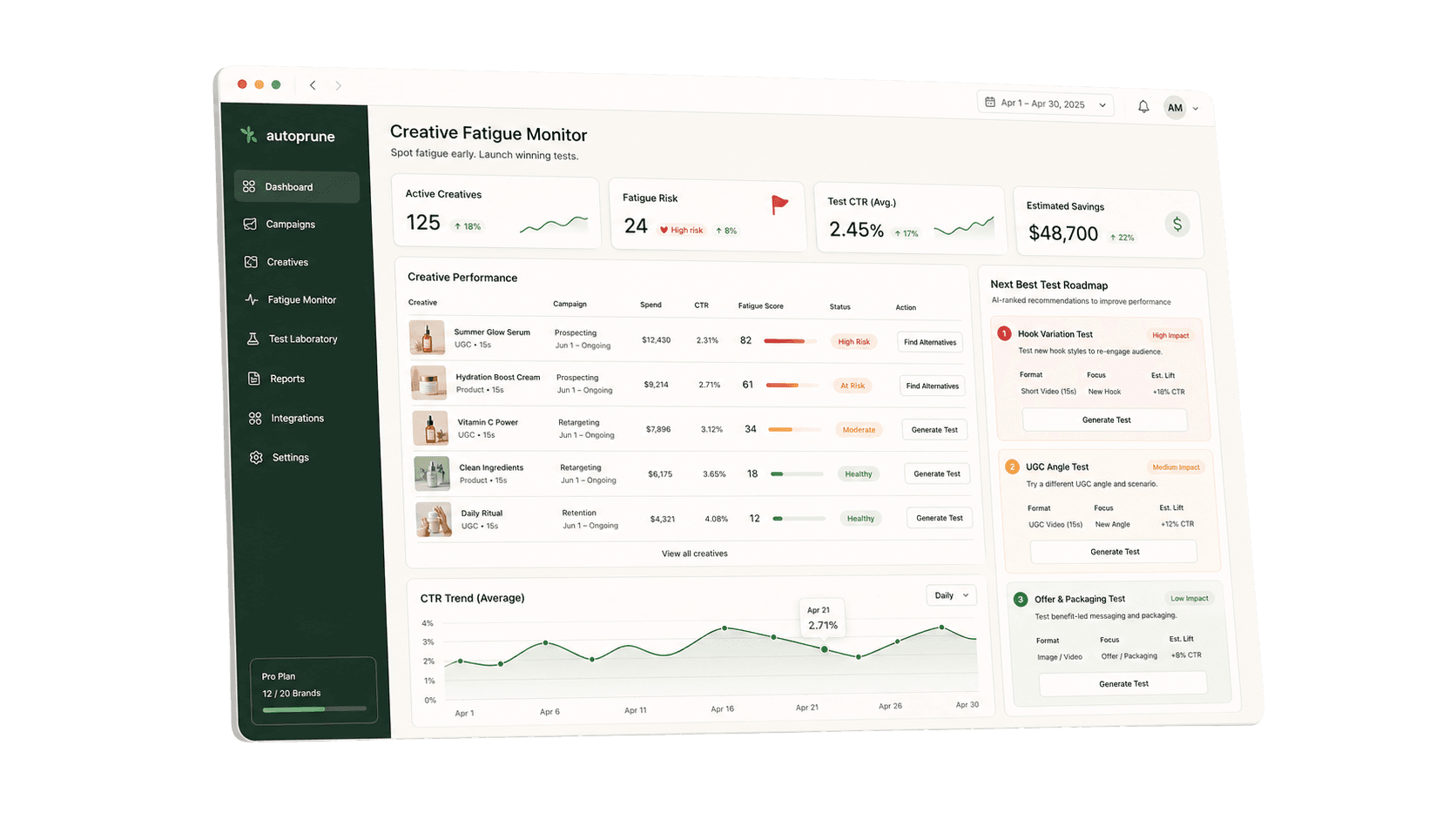
Monday review is where creative testing gets messy.
You open Meta. A few ads are still working, but not as cleanly as last week. One product needs a push. A founder dropped a customer quote in Slack that could become a strong hook. Another campaign has three versions of the same test, all named slightly differently, and nobody remembers which one was supposed to be the control.
The question is not just, "What ad should we make next?"
For a lean Shopify team, the better Monday question is:
What changed last week, what decision does that create, and what do we need to check next Monday?
Most small ecommerce teams do not only have a creative-ideas problem. They have a weekly decision workflow problem. Ideas, tests, results, and cleanup tasks get spread across spreadsheets, naming conventions, Slack notes, founder memory, and the Meta account itself.
A simple Monday workflow helps keep those pieces connected.
The 30-minute Monday creative testing template
This does not need to become a heavy operating system. The goal is to make one weekly review easier to run and easier to repeat.
Use 30 minutes to answer four questions:
- What changed last week?
- What deserves a new creative angle?
- What should be paused, scaled, refreshed, or cleaned up?
- What gets logged for next Monday?
Here is the cadence.
Minutes 0-10: Review what changed
Start with the signals, not the ideas.
Look for:
- winners that are slowing down
- ads that stopped producing useful signal
- fatigue signs in hooks, formats, or audiences
- product or collection pressure from inventory, seasonality, or promotions
- spend shifts that changed the quality of last week's data
- repeated customer language from reviews, comments, support, or founder notes
The output of this first step is a plain-language summary of what changed.
Examples:
- "The bundle ad is still converting, but the first hook is tiring."
- "The skincare collection needs a fresh push before next week's promo."
- "Customer reviews keep mentioning travel use, but we have not tested that angle."
- "The account is getting harder to read because the same angle is duplicated under three names."
Do not turn this into a full performance report. The point is to identify the signals that force a decision.
Minutes 10-20: Choose the next decisions
Now separate the decision types.
A new angle decision answers: what should we test next?
A pause / scale / refresh / cleanup decision answers: what should we do with what already exists?
This split matters. If the two get blended, teams often generate more creative when the real problem is messy learning. Or they clean up the account when the real opportunity is a new customer angle that has not been tested yet.
Choose a small number of decisions for the week:
- one new angle to test
- one existing ad, campaign, or concept to pause, scale, or refresh
- one cleanup item if the account is getting harder to interpret
The controlled decision types are:
- New angle: create a new test around a product, customer problem, use case, objection, review, or hook
- Pause: stop spending attention or budget on something that no longer produces useful performance or learning
- Scale: give a stronger signal more budget or attention carefully
- Refresh: keep the concept, but change the execution because the existing version is tired
- Cleanup: fix naming, structure, duplicates, notes, or clutter that prevents clear decisions
- Keep watching: wait because there is not enough signal yet
Minutes 20-30: Log next Monday's checkpoint
The final 10 minutes are where the workflow becomes repeatable.
For every decision, write down:
- what changed
- source of signal
- decision type
- action
- why this decision
- next check
Keep why this decision separate from next check.
That distinction is small but important. "Why this decision" explains the judgment you made today. "Next check" tells future-you what signal will prove whether the decision was worth continuing.
A simple weekly testing log you can copy
Use this as a lightweight Monday artifact. Add or remove columns if needed, but keep the core separation between signal, decision, reason, and next check.
| Week | Product / SKU | What changed | Source of signal | Decision type | New angle / cleanup action | Why this decision | Next check |
|---|---|---|---|---|---|---|---|
| May 12 | Travel skincare kit | Reviews keep mentioning "fits in my carry-on," but current ads lead with ingredients | Customer review language + support notes | New angle | Test travel-use hook against current ingredient-led control | Product still has momentum, but the current angle may be missing the strongest buying context | Compare thumb-stop / CTR and early purchase signal next Monday |
| May 12 | Bestselling leggings | Winner is slowing, but comments still mention fit and comfort positively | Meta performance trend + comment themes | Refresh | Keep the fit/comfort concept, but test new UGC opening and first 3 seconds | The concept may still be valid; the execution looks tired | Check whether refreshed creative recovers attention without worse conversion quality |
| May 12 | Summer bundle | Three active tests use different names for the same bundle angle | Naming drift in Meta + spreadsheet mismatch | Cleanup | Rename active tests by product + angle + date, then merge notes into one row | The team cannot compare learning while the same test is scattered across names | Check whether next review is faster and duplicate spend is easier to spot |
| May 12 | New accessory SKU | Early spend is low and results are noisy | Meta account signal + founder Slack note that inventory is limited | Keep watching | Do not launch a second angle yet; hold until the current test gets enough signal | More creative would add noise before the first test is readable | Review after another week or once spend reaches the agreed threshold |
The cleanup row is not a side issue. For lean teams, cleanup is often what protects creative learning.
If ad names drift, old hypotheses disappear, and the same concept gets relaunched without context, the team can end up "testing" without actually learning. A cleanup decision can be the highest-leverage creative testing move of the week because it makes the next decision clearer.
How to choose the next creative angle
When the log points to a new angle, do not start with a blank page. Start from the pressure already visible in the business.
Start from product pressure
Ask:
- Which product or collection needs momentum this week?
- Is there inventory, margin, seasonality, or promotion pressure?
- Does an existing winner need support from a new concept?
This keeps creative testing tied to business priorities instead of random ad ideas.
Start from customer language
Customer language is one of the fastest ways to find a new hook.
Look at:
- reviews
- support tickets
- comments
- post-purchase survey answers
- founder sales notes
- repeated objections
If customers keep describing the product in a way your ads do not, that is often a testable angle.
Example:
Product / SKU: Travel skincare kit
Current winner or control: Ingredient-led founder demo
New angle hypothesis: Buyers care more about travel convenience than ingredient education
Audience / problem this speaks to: Customers packing for short trips who want fewer bottles
What would make this angle worth continuing: Stronger hook rate and comparable conversion quality
What would make us stop it: Attention improves but purchase intent drops
Start from a winner that is slowing down
A slowing winner does not always mean the angle is dead.
Sometimes the concept is still right, but the execution is tired. In that case, the decision may be refresh, not pause.
Ask:
- Is the product still important?
- Are comments or reviews still validating the same reason to buy?
- Is the fatigue in the concept or the execution?
- Can the first 3 seconds, proof point, creator, format, or offer framing be refreshed?
This prevents a common mistake: killing useful learning because one creative version got tired.
How to decide what to pause, scale, refresh, or clean up
New angles are only half the workflow. The other half is deciding what to do with what already exists.
Use these categories during Monday review.
Pause
Pause when an ad, angle, or test no longer produces useful performance or learning.
This does not mean every weak result gets paused immediately. First ask whether the test was clear enough to judge. If the naming, comparison, audience, or spend level was messy, the better decision may be cleanup or keep watching.
Scale
Scale when the signal is strong enough to deserve more budget or attention.
Keep the decision specific. "Scale the winner" is less useful than "increase budget carefully on the review-led travel hook while watching whether CPA holds after spend increases."
Refresh
Refresh when the concept still makes sense, but the execution is losing strength.
Common refresh moves include:
- new opening hook
- new creator or UGC clip
- sharper product demonstration
- different proof point
- new first frame
- stronger objection handling
Cleanup
Cleanup when account clutter prevents clear decisions.
This can include:
- inconsistent naming
- duplicate campaigns
- unclear controls
- missing notes
- old tests still distracting the team
- creative folders that do not match what is live in Meta
Cleanup is not glamorous, but it is part of creative testing. If you cannot recover what was tested and why, you will keep repeating decisions.
Keep watching
Keep watching when there is not enough signal yet.
This is a decision too. It prevents overreacting to noisy early data or launching extra creative before the first test can teach anything.
Why this workflow matters for lean Shopify teams
Large teams can separate creative strategy, media buying, reporting, and account hygiene across different people. Lean Shopify teams usually cannot.
The same person may be:
- reviewing Meta performance
- choosing the next product push
- reading customer comments
- briefing creative
- cleaning up campaign names
- updating a spreadsheet
- explaining the decision to the founder
That is why creative testing breaks down between weeks. The idea, test, result, and next decision do not stay connected.
A Monday log gives the team a simple memory system:
- what changed
- what decision was made
- why it was made
- what to check next
It also keeps two different problems from getting confused.
Sometimes the team needs a better creative angle. Sometimes the team needs to prune, scale, refresh, or clean up what is already in the account. Both matter, but they should not be treated as the same decision.
Where software can help without replacing judgment
Software should not replace brand taste, customer understanding, or strategic budget judgment.
For this workflow, the useful role of software is narrower and more practical:
- remember prior hypotheses
- organize weekly decisions
- surface fatigue and repeated patterns
- connect customer language to possible angles
- keep cleanup work from hiding inside someone's head
- make Monday review less dependent on scattered spreadsheets, Slack threads, naming conventions, and founder memory
The goal is not "AI runs your ads."
The goal is a clearer weekly workflow around human judgment: what to test, what to pause, what to scale, what to refresh, and what to clean up.
Compare your Monday decision process
If your Monday Meta review already depends on a spreadsheet, naming conventions, Slack notes, and founder memory, autoprune is comparing weekly test / pause / scale workflows with a few Shopify teams running Meta every week.
Compare your Monday Meta decision process with Ramon or Catalina.